Showing posts with label American. Show all posts

Tuesday, September 24, 2013

OH, Cincinnati "Blue" Deaf American Bulldog X **Loves Everyone**


Blue (#502)

 Blueis a one year old, beautiful,deaf, male American Bulldog X.  Please help!!!  If you find you are not in a position to help now, please share with all your contacts.


He is currently being fostered by an SPCA volunteer and has been attending training classes every week.  Blue is completely deaf, so his foster mom taught him sign language, and he is now very good at listening to commands and following them. He will need an experienced owner will be able to continue working with Blue as he continues to grow out of his puppyhood stage. He is good with most other dogs as well as children.  He loves everyone he meets.

For additional information


Contact:


SPCA Cincinnati
3949 Colerain Avenue


Cincinnati, OH

Phone: 513-541-6100

Fax: 513-542-7722

 Blue (#502)

Monday, September 23, 2013

American Hairless Terrier small dog breed


The American Hairless Terrier is a breed of dog that was formerly considered a variant of Rat Terrier. As of January 1, 2004, the United Kennel Club deemed the AHT a separate terrier breed. It is often mistaken for a hairless Chihuahua.


History

Reputedly, the breed started when one hairless puppy appeared in one Rat Terrier litter in the state of Louisiana, United States, in 1972. Owners Edwin and Willie Scott liked the dog’s look and temperament, and upon maturity bred her hoping to reproduce the hairless quality. They were eventually successful; a litter produced in 1981 provided the foundation stock of the breed.

Recognition


In 1998 the breed gained recognition as the American Hairless Terrier by the American Rare Breeds Association and the National Rat Terrier Club. Canada was the first country outside the US to gain recognition, by Canadian Rarities in 1999. In 1999 the breed was recognized as Rat Terrier, Hairless Variety by the United Kennel Club. The UKC is the only governing body that recognizes the breed. While this organization is a national body, the breed is waiting for an international official breakthrough.
In the US the American Hairless Terrier Association is the provisional breed club. Other National Breed Clubs around the world include the Canadian American Hairless Terrier Association and the Japanese Hairless American Terrier Club.


About


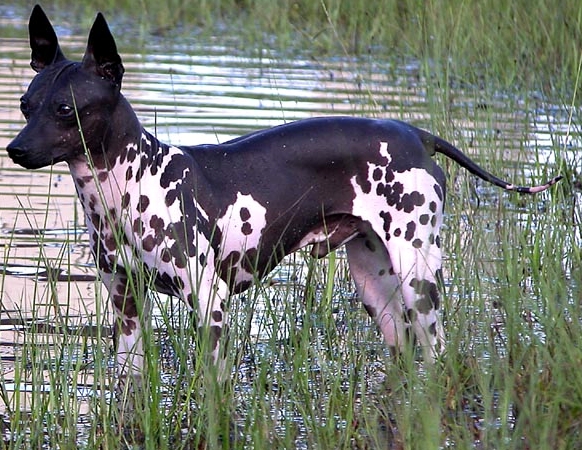
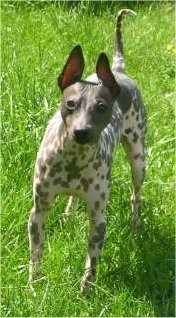
An adult American Hairless Terrier – Courtesy of Horizon AHTs. “This breed of dog is excellent for allergy sufferers. They have absolutely no body hair, no dander. Most people who cannot tolerate a Bichon, Poodle, Yorkie, or Wheaton Terrier can tolerate this breed. An allergy test is recommended before buying any breed where allergies or asthma are a problem.”

Description


In build, the American Hairless Terrier is identical to the medium-sized Rat Terriers, from whom he is directly descended. The American Hairless is a well-muscled dog with a deep chest, strong shoulders, solid neck, and powerful legs. The ears are carried erect when the dog is alert and are called bat, similar to the Rat Terrier’s. Tails must be full length. Bobs, either natural or docked are a disqualification.


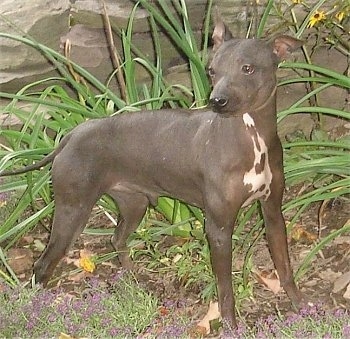
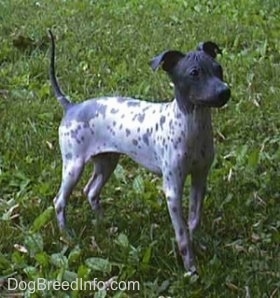
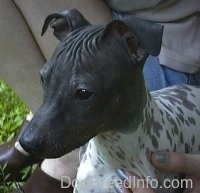
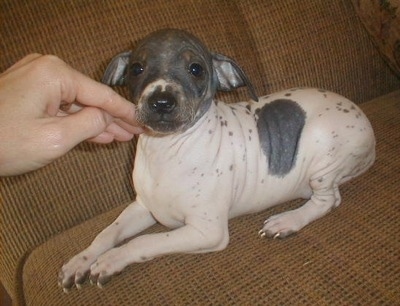
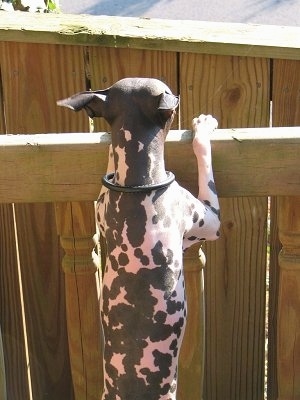
The skin is pink with gray, black, golden or red spots. Hairless-to-hairless breeding always produces completely hairless puppies. Hairless-to-coated mating is producing variable results, depending on chances and whether the coated dog is a carrier of the hairless trait. Hairless pups are born with a bit of sparse fuzzy hair all over their body. The pup will shed this fuzz, starting with the head, proceeding backwards, becoming entirely and eternally hairless by the age of six weeks. They do not have tufts of hair on the head, feet and end of tail, as do the Chinese Crested. They do however, have normal eyebrows and whiskers.

Temperament


American Hairless Terriers are intelligent, alert, playful and loving dogs. Very inquisitive and lively. This affectionate dog makes an excellent companion for anyone. They are good with children, especially if they are raised with them from puppyhood. The American Hairless Terrier, unlike other dog breeds, will break out in a sweat when hot or scared. They are fairly territorial, and like all dogs, need a human who understands how to be his leader. For the most part friendly with strangers. AHT’s make good watchdogs. They are not good swimmers and need to be closely monitored. These dogs are quick and very playful. The temperament of these dogs is pure terrier. They have the lively, feisty, fearless nature found in the best of terriers. Ratting cannot be recommended, due to the increased vulnerability brought on by the lack of a protective coat. This breed seems to train easily and are eager to please. Small dogs have the tendency to lack in human leadership. Be sure you are this dogs true pack leader in order to curve any negative behaviors.


Height, Weight


Height: 7-16 inches (18-41 cm.)
Weight: 5-16 pounds (2.5-7 kg.)


Health Problems


These dogs do not have absent premolars or any of the breeding complications associated with the hairless breeds. The AHT does not have the major skin problems commonly seen in hairless dogs. Sometimes they will get a rash on their skin. Because of their lack of hair, they do need protection from the sun. Sunscreen should be applied or a shirt should be worn, not only for the protection from the sun but from the cold as well. AHT’s do have sweat glands and will get pimples! They go away on their own. Rashes due to grass allergies are not that uncommon. Other allergies do occur as well.

Living Conditions


The AHT will do ok in an apartment so long as they get at least 20-30 minutes of exercise a day. They are fairly active indoors and should have at least a small to medium sized yard. AHT’s love to dig. Since they have sweat glands they do not drool at the mouth or pant in order to balance their body heat. They should wear a sweater in cold weather.

Exercise


The breed enjoys challenging games and outdoor romps. They need to be taken on a long daily walk.


Life Expectancy


About 14-16 years.


Grooming


The only special care required is preventing sunburn and keeping them warm in cold weather. They should be bathed one to three times a week, owners preference. Their nails should be trimmed weekly. If their skin becomes dry, lotion (without lanolin) can be applied. This breed obviously does not shed and they do not get fleas, but they do shed skin cells about every 20 days, therefore there is some dander but it is very minimal. AHT’s forget they do not have any hair and romp around outside.  Scratches and cuts do happen and they need to be attended to by hydrogen peroxide or any other antiseptic agent.
This breed is very good for allergy sufferers. Many AHT breeders have experiences , doing hands on and remote allergy tests with people who have allergic responses to dogs and more often than not, individuals who can not tolerate even those breeds who are known to be ‘hypoallergenic’… can tolerate an AHT. Studies have found them to be the best breed of dog for people with dog allergies. Many breeders can recount stories of grown men crying at the prospect of owning a dog for the first time in their lives. For those individuals and families who have never owned a dog before either due to their own allergies or a family members , holding a dog for the first time without a reaction is a rather powerful feeling for them.. !

Origin


In 1972, a remarkable thing happened: in a litter of mid-sized Rat Terriers, a completely hairless female was born. It became the prized pet of Willie and Edwin Scott of Louisiana, U.S.A. They named their hairless dog Josephine. The Scotts bred Josephine and produced one hairless female in her first litter, but through the next several litters, the little terrier failed to whelp any more exhibiting the hairless trait. Finally, at the age of nine years, she crowned her attempts by having a litter with two hairless pups, one of each sex. These hairless pups where the foundation of a breeding program to produce and stabilize the breed. The Scotts worked under the guidance of their geneticist and veterinarian. They named their new breed American Hairless Terrier. These are not just freak dogs. They differ substantially from the hairless types of Asia and Africa in that no Powderpuff variety is needed to obtain hairless pups, as the hairlessness gene is not semi-lethal dominant but autosomal recessive. Furthermore, these dogs do not have absent premolars or any of the breeding complications associated with the hairless breeds. For these traits, the Scott’s nude puppy and its progeny are truly remarkable and unique in the canine world. The Scotts are still working on establishing this breed. They are working toward keeping the temperament of the Rat Terrier while still maintaining the hairless trait.


Group

Terrier


Recognition


UKC, NKC, AHTF, AHRTC, CKC, APRI, ACR, DRA
The AHRTC is licensed by United Kennel Club . The breed is now recognized with UKC as a rat terrier/ hairless variety but will become a separate breed with UKC on Jan 1, 2004. The AHRTC will be then known as the AHTA, American Hairless Terrrier Association and the Provisional Parent Club for this breed with UKC.


Monday, September 16, 2013

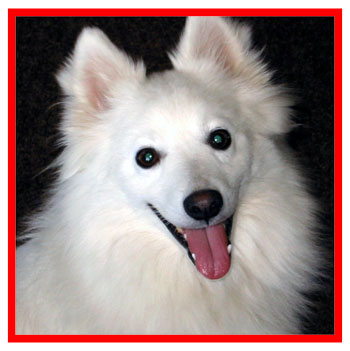
American Eskimo Dog small dog breed


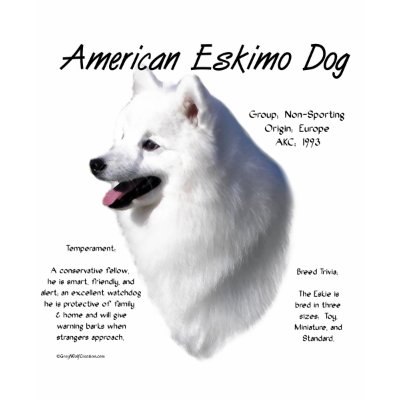
The American Eskimo Dog is a small to medium sized breed of dogs of the Spitz type, originating in Germany, and is one of the most ancient of the dog families, dating back almost 6,000 years. Originally the Standard German Spitz. Its closest relatives are the other German spitzes such as the Pomeranian. The American Eskimo Dog is a house dog, companion, and watch dog.


Appearance


The Eskie is built along classic Nordic lines, a form that has proved effective at pulling heavy loads through snow and ice. It is compactly built, slightly longer than tall. The stand-off, double coat resists soaking and provides insulation against the cold. The small thick ears are also cold-resistant. The breed’s smaller size has moved it from the realm of sled dog, but it remains a sled dog in miniature. The American Eskimo Dog stands furry with erect ears and a long tail curling over its back.
There are 3 separate size divisions in the American Eskimo Dog breed recognized by the American Kennel Club and the Canadian Kennel Club.
    * Toy, 9–12 in (23–30 cm) at the withers
    * Miniature, 12–15 in (30–38 cm) (most popular)
    * Standard, 15–19 in (38–48 cm)
Dogs over 19 inches or under 9 inches are disqualified at breed shows in the US and Canada, in order to discourage the breeding of oversize or excessively small dogs. The United Kennel Club in the US does not recognize the Toy variety.

History


The American Eskimo Dog “is a modern variation of a very ancient family of dogs.” Spitz type dogs developed in Arctic and northern areas of the world, with the larger types being used as sled dogs.But the Eskie was specifically bred to guard people and property and, therefore, is territorial by nature and an excellent watch dog. He is very loyal to his family and is known for being gentle and playful with children. He is energetic, alert and highly intelligent. In Northern Europe, smaller Spitz were kept primarily as pets and watchdogs, and eventually were developed into the various German Spitz breeds. European immigrants brought their Spitz pets with them to the United States, especially New York, in the early 1900s, “all of them descended from the larger German Spitz, the Keeshond, the white Pomeranian, and the Italian Spitz, the Volpino Italiano.”
Although white was not always a recognized color in the various German Spitz breeds, it was generally the preferred color in the US. In a display of patriotism in the era around World War I, dog owners began referring to their pets as American Spitz rather than German Spitz. This name change was similar to the use in the United States of the term Freedom fries rather than French fries to refer to a popular potato dish during disputes between France and the United States before the 2003 invasion of Iraq.


After World War I, the small Spitz dogs came to the attention of the American public when the dogs became popular entertainers in the American circus. In 1917, the Cooper Brother’s Railroad Circus featured the dogs. A dog named Stout’s Pal Pierre was famous for walking a tightrope with the Barnum and Bailey Circus in the 1930s. Due to the popularity of the circus dogs, many of today’s American Eskimo Dogs can trace their lineage back to these circus dogs.
After World War II, the dogs continued to be popular pets. Postwar contact with Japan led to importation into the United States of the Japanese Spitz, which may have been crossed into the breed at this time. The breed was first officially recognized as the “American Eskimo” as early as 1919 by the American United Kennel Club (UKC), and the first written record and history of the breed was printed in 1958 by the UKC.[9] At that time there was no official breed club and no breed standard, and dogs were accepted for registration as single dogs, based on appearance. In 1970 the National American Eskimo Dog Association (NAEDA) was founded, and single dog registrations ceased.


 In 1985 the American Eskimo Dog Club of America (AEDCA) was formed by fanciers who wished to register the breed with the American Kennel Club (AKC). Following the AKC’s requirements for breed recognition, the AEDCA collected the pedigree information from 1,750 dogs that now form the basis of the AKC recognized breed, which is called the American Eskimo Dog. The breed was recognized by the American Kennel Club in 1995. The stud book was opened from 2000 to 2003 in an attempt to register more of the original UKC registered lines, and today many American Eskimo Dogs are dual-registered with both American kennel clubs. The breed is also recognized by the Canadian Kennel Club as of 2006, but is not recognized elsewhere in the world.
The American Eskimo Dog is not an internationally recognized breed, and since neither of the American kennel clubs are affiliated with the Fédération Cynologique Internationale, fanciers wishing to participate in international dog shows will register their American Eskimo Dogs as the very similar German Spitz. This is done only by individuals wishing to participate in dog sports in international shows, and does not mean that the American Eskimo Dog and the German Spitz are the same. The breeds may have the same general origins, but have developed differently over the past 100 years.


Health


Health testing should be performed by all responsible breeders and anyone purchasing a puppy should be aware of the genetic problems which have been found in some individuals of the breed, such as PRA (Progressive Retinal Atrophy), luxating patella, and hip dysplasia. None of these are common and the breed is generally healthy.
In addition to the problems above, the breed can have a tendency towards allergies and tear-staining, and the propensity towards these traits is inherited.


Temperament


American Eskimo Dogs along with other Spitz were bred to be house dogs and companion dogs, and thrive on being a part of a human family. The Eskie is highly intelligent, eager to please, very active, has lots of energy, and moderately independent. At home, these lively dogs make excellent watchdogs, barking to announce the presence of strangers. The Eskie can be protective of its home and family, but in general they will not threaten to attack or bite a person unless provoked. As with all dogs, behavior is partially inherited and partially trained. Some dogs are prone to excessive barking and separation anxiety. It is important for puppy buyers to research pedigrees as temperament may vary due to inheritance.


Grooming and training


Eskie’s double coat needs brushing and combing twice weekly, more often when their biannual shedding occurs. An undercoat rake, a tool available at most pet stores, is useful for brushing out the heavy undercoat. Some owners in hot climates do shave their Eskies, but if this is done, the dogs should be kept indoors as much as possible to prevent sunburn. The breed’s shedding, along with its active temperament, results in some dogs being taken to animal shelters or otherwise put up for adoption. Owners should contact breed-specific rescue groups that will give advice on grooming, training or curbing behavioral issues.
American Eskimo Dogs are very energetic and require daily exercise, the extent of the workout depending on the size of the dog. Owners can avoid problems by socializing their Eskie through obedience training or participating in dog sports, such as dog agility, flyball, and dancing.